Highlights WP1 and 2025 Clinical Advances : Overcoming Adaptive Resistance in Targeted Therapy for NSCLC
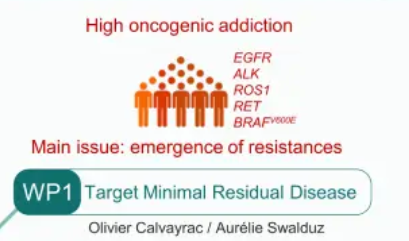
Patients with non-small cell lung cancer (NSCLC) harboring genetic alterations in EGFR, ALK, ROS1, or BRAF-V600E generally respond to targeted therapies (TT) but frequently develop resistance, highlighting the need for combination strategies to overcome or prevent such resistance. In 2025, several clinical trials reported benefits from combination therapies with TT, including the FLAURA2 trial (NEJM 2025), which showed improved survival for EGFR-mutant patients treated with osimertinib plus chemotherapy versus osimertinib alone, and the MARIPOSA trial (NEJM 2025), which demonstrated superior survival with amivantamab plus lazertinib compared to osimertinib. However, despite these notable benefits, many patients still developed resistance, highlighting the need to better characterize and target the residual disease driving its emergence. In this context, a proof-of-concept preclinical study demonstrated that ADCs or CAR-T cells could target TROP2, a protein expressed by residual tumor cells following osimertinib treatment (Baldacci, Cancer Discov 2025), paving the way for new strategies based on surface marker–directed targeting of resistant cells. Within COALA’s WP1, multiple studies are actively developing strategies to prevent adaptive resistance. Several preliminary findings have already been presented at leading international congresses in 2025 (AACR, WCLC, EACR), highlighting the strong and promising contributions of COALA’s researchers and clinicians.