
Highlights WP5: Methodological integration and innovation
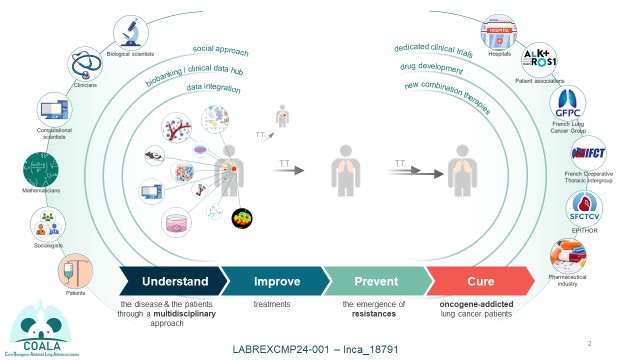
Recently, the NetB(IO)² team led by Dr. Vera Pancaldi used a bioinformatics approach to identify different subgroups of immune cells within lung tumors that may be associated with a good or poor prognosis for patients (Hurtado M. et al., Front Immunol 2024).
Understanding the function of these immune cells could help predict which patients are more likely to respond to treatment, based on data that is often available in a clinical setting and innovative bioinformatics approaches presented at the World Bioinformatics Conference in Liverpool and the World Lung Cancer Conference in Barcelona in 2025.
References:
Hurtado M, Khajavi L, Essabbar A, Kammer M, Xie T, Coullomb A, Pradines A, Casanova A, Kruczynski A, Gouin S, Clermont E, Boutillet L, Senosain MF, Zou Y, Zhao S, Burq P, Mahfoudi A, Besse J, Launay P, Passioukov A, Chetaille E, Favre G, Maldonado F, Cruzalegui F, Delfour O, Mazières J, Pancaldi V. Transcriptomics profiling of the non-small cell lung cancer microenvironment across disease stages reveals dual immune cell-type behaviors. Front Immunol. 2024 Oct 31;15:1394965. https://pubmed.ncbi.nlm.nih.gov/39606240/
P2.06.43 Estimating Tumour Microenvironment Cellular States From Bulk RNAseq Produces Biomarkers of Clinical Outcome Across Stages
Hurtado, M. et al.
Journal of Thoracic Oncology, Volume 20, Issue 10, S308 - S309
https://www.jto.org/article/S1556-0864(25)01627-2/abstract